
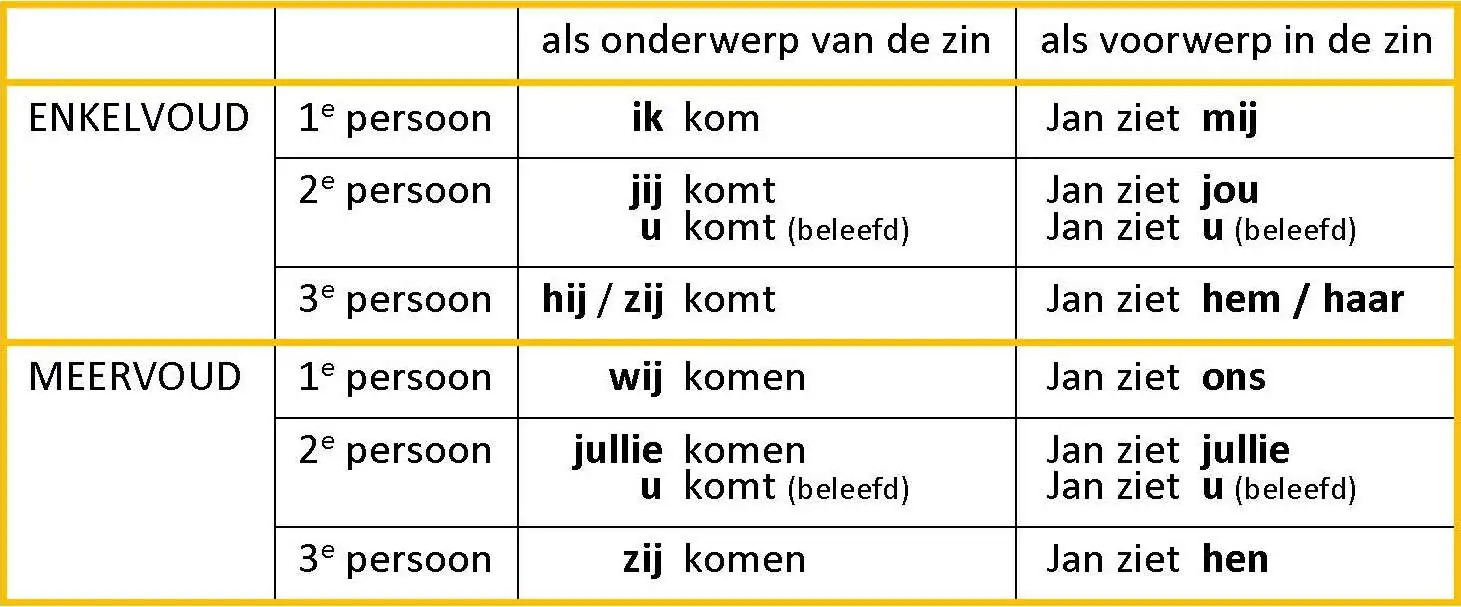
| Learn those pronounces, in Dutch we use them a lot! A personal pronoun is a word that replaces a noun* or a proper name that identifies a person or thing. You need to learn the pronounce(s) in order to know how to conjugate a VERB.[*a word (other than a pronoun) used to identify any of a class of people, places, or things (common noun), or to name a particular one of these (proper noun).]
Examples: That house is his (HEM), They help me when i (IK) have a problem, We (WIJ) are waiting for him. [** It (HET) can be an article, but it can also be a personal pronoun. If it has a noun after it, it is an article. When it stands alone, it is a personal pronoun. ] A possessive pronoun (bezittelijk voornaamwoord) indicates who owns something. It always precedes a noun and replaces the article (DE, HET, EEN). Examples: my (MIJN) room, our (ONS) house, his (ZIJN) new clothes
IMPORTANT!: singular: ik, jij, je, zij, ze, u, mijn, jouw, je, uw, zijn, haar |
|||||||||||||||||||||||||||||||||||||||||||||||||||

| ik (i) | Ik zit op mijn fiets | |
| je (you) | Je zit op de fiets | |
| jij (you) | jij zit op de fiets | |
| jou (you) | Ik zag jou op de fiets | |
| u (you) | U zit op de fiets | |
| hij (he) | Hij zit op de fiets | |
| zij (she) | Zij zit op de fiets | |
| ze (she) | Ze zit op de fiets | |
| wij (we) | Wij zitten op de fiets | |
| we (we) | We zitten op de fiets | |
| jullie (you-plural) | Jullie zitten op de fiets | |
| zij (they-plural) | Zij zitten op de fiets | |
| mij (me) | Kom jij naar mij toe? | |
| me (mine) | Het maakt me niets uit | |
| hem (his) | Het maakt hem niets uit | |
| haar (hers) | Het maakt haar niets uit | |
| ons (our) | Het maakt ons niets uit | |
| hen (them) | Ik geef snoepjes aan hen | |
| hun (their) | Het is hun huis | |
| ze (them-plural) | Ze wonen in het huis |