
LESSON ONE
Welcome to your first Dutch lesson at Fast ‘N Snel. Great that you want to learn Dutch! Fast ‘N Snel focuses on speaking Dutch. But there are also grammatical rules that you need to know when speaking Dutch.
Let’s start at the beginning!
Persoonlijke voornaamwoorden
(Personal pronouns)
Personal pronouns refer to living beings or things, without calling them by name: I, you, she, them, him, etc. There are three ‘types’ of personal pronouns:
Eerste persoon, tweede persoon, derde persoon
(First, second and third person)
In the first lessons we often talk about the “First Person”, “Second Person” and the “Third Person”.
A short definition:
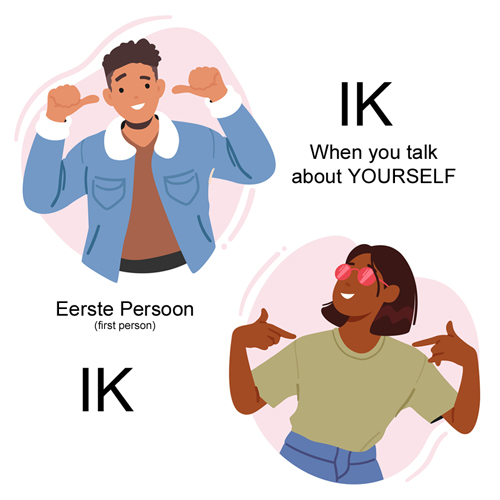
- first person: the speaker
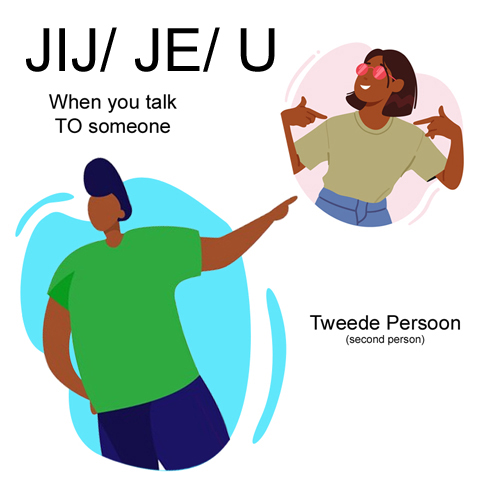
- second person: the person addressed
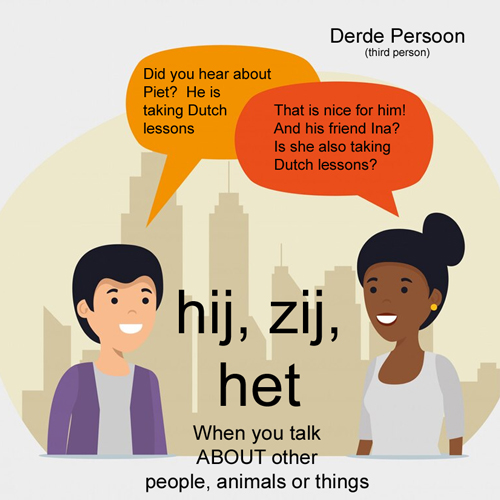
- third person: neither the speaker nor the person addressed, but a third person/ animal/ thing
For each person there is also a singular and a plural ‘version’. For now we will focus mainly on the singular.
So……let’s start with how to introduce yourself in Dutch….
You can present yourself in different ways. There is of course a big difference between presenting yourself to friends or colleagues or presenting yourself at a job application. In both cases, there is a fixed order for telling people who you are and what you do.
| Nederlands/ English | Explanation |
|---|---|
Ik |
“ik” (I) is used in Dutch when you talk about yourself |
1- Ik heet…/ mijn naam is… |
Used when you introduce yourself, as in: “Ik heet Jan“ (My name is Jan) |
2- Ik ben geboren in…/ Ik kom uit… |
To tell where you originally from, as in: “Ik ben geboren in Nederland“ (I’m born in The Netherlands) |
3- Ik woon (nu) in… |
To tell where you live now, as in: “Ik woon in Amsterdam“ (I’m living in Amsterdam) |
4- Ik werk voor of ik werk bij… |
To tell where you work, as in: “Ik werk bij Google“ (I’m working for Google) |
5- Ik ben (een)… |
Used when you tell what you are or how you feel, or for example what your occupation is, as in:
“Ik ben mens“ (I am human). You can also use it to introduce yourself by name: |
de |
The 3 words DE, HET & EEN (the, the, a) are often used in Dutch, they are called LIDWOORDEN (articles). |
het |
The 3 words DE, HET & EEN (the, the, a) are often used in Dutch, they are called LIDWOORDEN (articles). |
een |
The 3 words DE, HET & EEN (the, the, a) are often used in Dutch, they are called LIDWOORDEN (articles). |
De man, een man |
In Holland you are called MAN (man) when you are older then 18. |
De vrouw, een vrouw |
In Holland you are called VROUW (woman) when you are older then 18. |
De jongen, een jongen |
In Holland you are called JONGEN (boy) when you are younger then 18. (The Dutch use the diminutive JONGETJE for kids.). |
HET meisje, een meisje |
In Holland you are called MEISJE (girl) when you are younger then 18. (The Dutch use the diminutive MEISJE for kids.). |
HET kind, een kind |
Every person between 2 -3 and 18 years the Dutch call “KIND“ (kid) |
De baby, een baby |
Every person age 0 to 2-3 the Dutch call “BABY“ (baby) |
HET persoon, een persoon |
Mostly used when you not know if it’s a man, woman or kid. “een persoon“ (a person) is singular, “personen“ (persons) is plural. |
Een dier, het dier |
Dutch talk about “een dier“ (an animal) when they tell – for example – about a cat or dog. |
Hallo |
Greeting, most used in a familiar situation |
Hoi |
Greeting, most used in a familiar/ street situation. |
Goed |
Can be used in different ways, as in: “Ik voel mij goed“ (i feel good) or “dat eten is niet meer goed“ (That food is no good anymore) |
Slecht |
Can be used in different ways, as in: “Ik voel mij slecht“ (i feel bad) or “Hij is een slecht persoon“ (That person is bad) |
Dag, een dag, de dag. Plural: Dagen |
maandag (Monday), dinsdag (Tuesday), woensdag (Wednesday), donderdag (Thursday), vrijdag (Friday), zaterdag (Saturday), zondag (Sunday). |
Nacht, de nacht, een nacht. Plural: nachten |
|
Maand, de maand, een maand. Plural: Maanden |
|
De ochtend, ‘s ochtends |
In Holland from 06:00 till 12:00 (same as ‘s Morgens) |
De morgen, ‘s morgens |
In Holland from 06:00 till 12:00 |
De middag, ‘s middags |
In Holland from 12:00 till 18:00 |
De avond, ‘s avonds |
In Holland from 18:00 till 24:00 |
De nacht, ‘s nachts |
In Holland from 24:00 till 06:00 |
Morgen |
Not to confuse with “MORGEN” as in the morning, it can also mean:“Ik zie je morgen“ (I will see you tomorrow) |
Goedemorgen |
Greeting often used in the morning, also used in familiar situations. |
Goedemiddag
|
Greeting used in the afternoon, more for official situations or with people you don’t know well. |
Goedenavond |
Greeting used in the evening, more for official situations or with people you don’t know well. |
Goedenacht |
Greeting used at night or in the evening. |
Goedendag |
Greeting used during the day, more for official situations. |
Tot ziens |
Most used in a familiar situation, when you leave. |
rev. 110624